
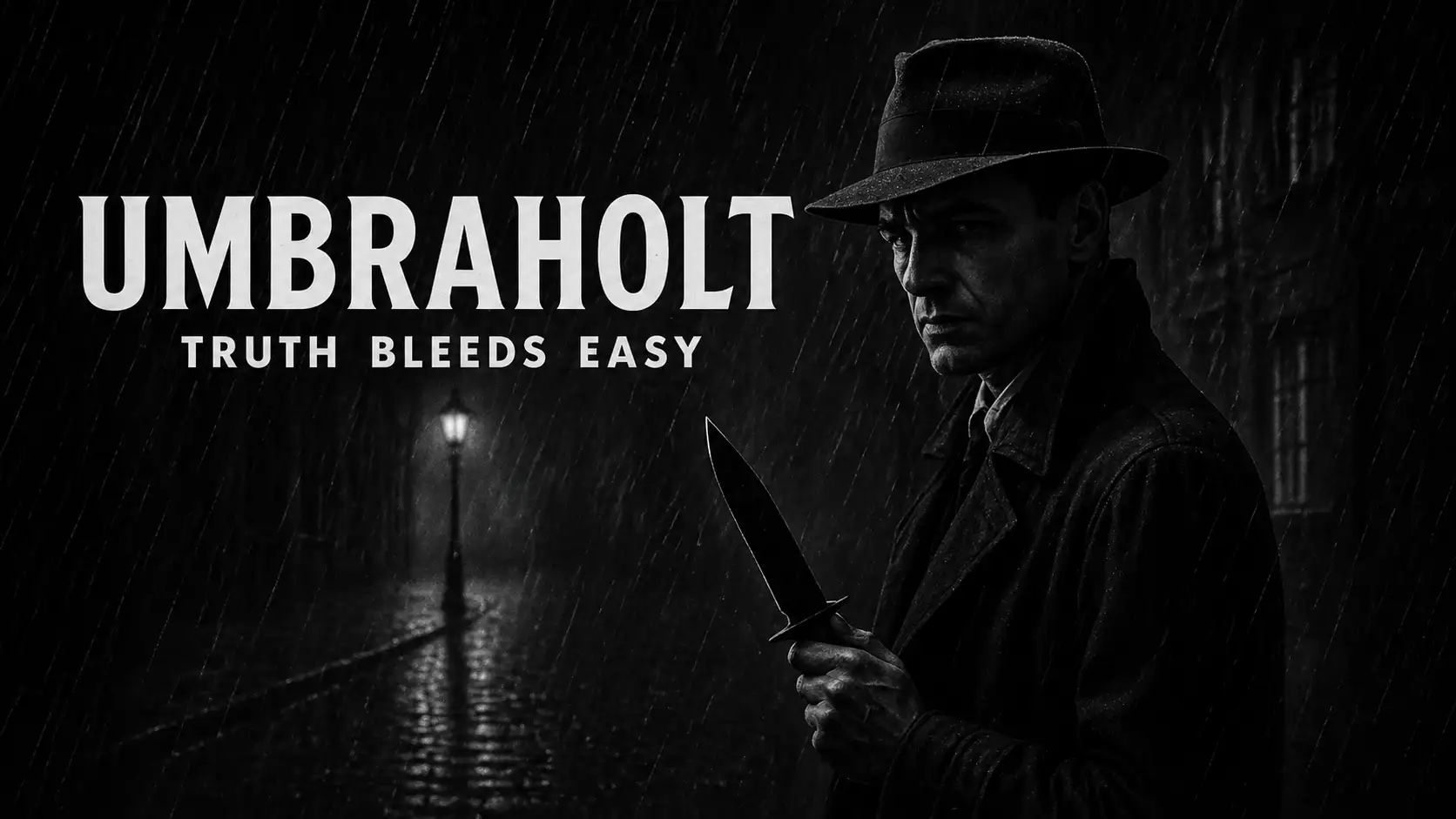
Truth bleeds easy.
Prologue
Umbraholt doesn't sleep. It rusts.
It's a city of vertical graves. A stack of iron and stone aspirations piled so high they tore holes in the sky and forgot what the sun looked like. Down here, in the perpetual twilight of the Midvaults, the only stars are the sparks from a failing power conduit or the glint in a thief's eye. The air tastes of wet metal, ozone, and the kind of regret that settles deep in your bones.
Rain is the city's lifeblood. A constant, acidic drizzle that washes the soot and sins from the upper tiers down to the gutters where they belong.
My name is Tareth Sylmaren, and I used to be a Starwright. Back when there were stars to wright, and the Guild hadn't yet choked on its own hubris. I knew the celestial harmonics, the precise calibration needed to draw power from the Cygnus Array, the art of weaving starlight into the city's grid. Now, I'm what's left over: a courier, a fixer, a man who knows which rust-caked conduits still carry a trickle of power and which secrets are better left buried in the city's foundations. My tools are no longer celestial calibrators, but a cynical heart and a talent for walking through shadows without making new ones.
This morning, like most mornings, began with a lie.
I was in a grimy substation near the Gutter Pits, trading a patched-up power cell for information. The broker, a weasel-faced man named Jax, held the cell up to the dim light. "This is a B-grade charge at best, Tareth. The information you want… it costs A-grade."
"The information I want is the name of the Syndicate lieutenant shaking down the water merchants in the lower tier," I said. "The job pays me. I pay you. The city keeps turning. Don't make it complicated."
Jax licked his lips. "Vask," he muttered. "Lurien Vask. Senior Acquisitions. He's not just shaking them down. He's… reorganizing. Calls it 'resource optimization.' People who don't optimize… they disappear."
I nodded. The Syndicate's euphemisms were as sterile as their methods. They didn't murder; they 'decommissioned assets.' They didn't extort; they 'enforced service levies.' It was a cleaner, colder kind of evil. Corporate. The Spire's hunter-killers had him marked — signal flaring like blood in water.
I left Jax to his shadows and walked toward the Syne Bridge district. I passed a food stall where a mother was watering down a thin protein soup for her child. In the alley behind it, a Syndicate Enforcer stood perfectly still, his featureless helmet reflecting the flickering neon of a noodle bar. He wasn't doing anything. He was just watching. That was their new trick. Not overt force, but the certainty of its presence.
I thought of Kael, my old partner from the Guild. He would have tried to reason with the Enforcer. He believed in the city's bones, in the idea that what was broken could be mended. He died trying to patch a failing conduit on his own time, a believer to the last. The Syndicate's official report called it an accident. I called it what happens when you have hope in a city that eats it for breakfast.
That's why I took the meeting. A whisper in a smoke-filled tavern, a name passed on a folded scrap of paper. A dead drop and a simple delivery. Quick money. He told me to be on the copper stairs at sundown. A simple job, he'd said. No complications.
In Umbraholt, that's the first lie.
Act I
The bundle was waiting for me in a rusted maintenance locker, just like the contact said. It was wrapped in veilhide, and the moment my fingers touched it, a cold dread snaked up my arm. The fabric was coarse and tacky, smelling of burned vellum and something else, something metallic like old blood or older secrets. Every few steps, as I made my way to the rendezvous, it gave a faint, rhythmic throb. Not heat, not the familiar tingle of charged starstone. It was a pulse of pure pressure, a non-sound that vibrated deep in my bones. It felt like I was carrying a captive heartbeat.
The buyer was supposed to meet me by the copper stairs. I arrived five minutes early. A professional is punctual. A survivor is early. He was already there, which meant he was either an amateur or he was dead.
He was dead.
Slouched against a rusted conduit pipe, head tilted back as if trying to catch a final glimpse of a sky he couldn't see. No blood. No scorch marks. No visible trauma at all. Just… gone. His eyes were open, his mouth slack. His fine upper-tier coat — the kind with enameled fastenings and the subtle crest of a Minor House — already looked like a shroud.
I scanned the upper walkway. A shape moved two levels up, then melted into shadow.
I needed to know what I was holding. Stepping back from the body, I unwrapped the parcel.
What I saw didn't catch the light — it devoured it.
A knife. But that word is too simple, too plain for what it was. It was a shard of pure nothingness, a hole in the world shaped like a blade. Its edges were impossibly sharp, not because they were honed, but because they represented a perfect cessation of reality. The metal, if it was metal, was blacker than pitch, blacker than memory. The rain didn't bead on it. The drops simply vanished a hair's breadth from the surface, like they'd never existed at all. Even the dim orange spill from the nearest street lamp seemed to recoil, the light bending away at the edges as if in fear.
And standing there, on a forgotten bridge in a dying city, with a fresh corpse behind me and that impossible thing humming in my hand like it knew my name, I forgot how to breathe.
With a sharp pop, the lamp above us cracked. A second later, the light went out, plunging the entire platform into profound darkness.
The smart thing would have been to drop it right there. Let it fall into the chasm below and become someone else's funeral.
But the thing in my coat felt like power. The power to unmake.
Act II
She stood in the mouth of an alley, a slash of clean lines and expensive fabric against the tier's grime. She had the same aristocratic bearing as the dead man, the same unshakeable fire in her eyes, but hers was laced with raw, desperate fear.
"My brother's name was Lyren," she said. "He wasn't buying that thing."
I gave her a look that had convinced tougher people to walk away. "Lady, your brother was meeting a courier on a dark bridge for a relic wrapped in veilhide. He wasn't collecting stamps."
"He was part of a faction," she snapped. "A secret group within the Houses. We believe Starvein is connected to the Dimming."
She froze as the heavy, rhythmic tread of an Enforcer patrol echoed down the street. She pulled me deeper into the alley's shadows, her grip surprisingly strong. We pressed against the cold, wet brick.
She let out a shaky breath. "They're everywhere now. They took my father for asking too many questions."
She fumbled inside her coat and produced a small, silver locket. One side: a faded photograph. The other: a constellation inked in frantic lines, smeared in old blood.
The image hit me harder than a stun-blast. It was the Weaver's Knot, but with a jagged line cut right through its center. Underneath it, two words: Cut it.
It was a phrase from the old Guild heretics. They believed some celestial phenomena weren't acts of creation, but of unmaking. I once delivered a sunstone to a monk who claimed it whispered to him. He wanted to burn it, said it was a lie pretending to be a star. I took his money and walked away.
"Then play for the side that's trying to keep the lights on, not the one profiting from the dark," she pleaded. "Lyren believed the Knife could be unmade at the Seam. I'll pay you double what my brother offered. Not to deliver it. Not to sell it. To finish his work."
She was either a damn good liar or a fool about to get us both killed. In Umbraholt, there was rarely a difference.
Act III
My next stop was Fenris's stall — the only data-scrapper in the Midvaults I trusted not to sell me out for the price of a hot meal.
As I placed the slate on his counter, I glanced at a shelf of old Guild tools. For a second, I couldn't remember what the third object was. The name was on the tip of my tongue, a ghost of a word. I couldn't remember what it did. Not really. Not anymore. A wave of vertigo washed over me, and the Knife under my coat pulsed faintly, as if in satisfaction.
Fenris worked the hack, and a single file projected into the dusty air: "Acquisition Log: Starvein." A list of names scrolled by. Buyers. Researchers. Couriers. All marked with a stark, red Terminated.
The name on the list above mine was Lyren Eltharil. So Thalenya was a fool, not a liar.
As I stared, I tried to picture Kael's face, to remember the arguments we'd had in this very shop. But his features were blurry, the memory worn thin at the edges. The feeling was like trying to hold smoke.
A shadow fell over the doorway. A man built like a brick tower, wearing the immaculate dark coat of a Syndicate enforcer. "The slate," he rumbled. "And the package."
I swept a stack of star-charts off the counter. As the big man flinched, I bolted for the back curtain. A heavy, armored hand clamped on my shoulder, strong enough to crush bone. I twisted, swinging the satchel with the Knife in it in a desperate, panicked arc.
The bag connected with his side.
He didn't grunt. He didn't stagger. The air rippled, and for a second, I tasted rust and oblivion. The enforcer just went still. A look of profound confusion crossed his face. Then, with a soft, final sigh, he crumbled into a pile of fine gray dust and tailored wool.
I stood there, my lungs burning, my heart hammering. I had just killed a man. No — I had un-made him. And as I looked at the dust, the name Koris evaporated from my mind, leaving only a hollow space where a memory had been.
The spell broke. I didn't answer. I just ran.
Act IV
Two streets away, leaning against a graffiti-scarred wall as if he'd been expecting me, stood Lurien Vask. He wasn't smiling.
"That was messy," he observed. "Koris was useful. A loyal, if unimaginative, asset. You've become a significant complication, Sylmaren."
He stepped closer. "You think we're just gangsters? Thugs in nice coats? Look around you. This city is dying. The Dimming was a sickness that ate the stars. Now the rot is setting in. We are the surgeons. The Syndicate maintains the power grids the Guild abandoned. We are the only thing holding Umbraholt together from collapsing into absolute chaos."
"That knife isn't a weapon. It's a tool. A scalpel. In the right hands, it can erase a slum. It can cut a failing power grid from the ledger of reality so we can build a new one in its place. It can excise corruption, rebellion, decay. It can prune the rot so the tree can live."
It was a beautiful, terrible speech. The logic was cold, clean, and utterly monstrous.
"And if I say no?" I asked.
"Then you are part of the rot," he said. "And you will be cut away."
He vanished back into the mist. I doubled back to Fenris's stall, but I was already too late. His stall was a wreck. Fenris was gone. Another debt on my ledger, one I knew I could never pay.
I stumbled back to my rooms. I took out a family keepsake — a small memory stone etched with my father's voice telling me stories of the stars when I was a boy. I played it.
Silence.
Not a malfunction. The stone was warm, active. But the memory was gone. Sliced out of existence. The Knife hadn't just been in my coat; it had been in my life, cutting away the things that tied me to the past. It was deciding what mattered. And it was deciding without me.
I ran. I ran to the one person left who might understand. Myraen's observatory tower.
"The Weaver's Knot," she whispered when I arrived, her voice thin with a fear I'd never heard from her before. "Tareth… how many stars are in the Weaver's Knot? I can't… I can't see them in my head anymore. There's a hole where they should be."
"It's not just taking your past, Tareth," she said, her usually steady hand finally trembling. "It's taking mine. It's un-writing our history. The last thing we have left. The foundation of who we are."
"Then I'll destroy it," I snarled. "I'll throw it in a furnace."
"No!" Her grip tightened. "Its very nature is absence! To destroy it might unleash that absence completely, unmaking everything. But the Un-forging… the Guild heretics believed that if an artifact's purpose was to unmake, the only way to destroy it was to give it a target it couldn't cut without unmaking itself. To turn its fundamental nature upon its own being."
"They said it would require a fulcrum," she whispered. "An impossible price. A memory so fundamental, so core to the wielder's own identity, that offering it to the blade would create a paradox. A memory of a beginning. If the blade cuts the wielder's own foundation, it severs the will that binds it."
Her words hung in the air, a challenge and a death sentence.
Act V
That night, I stood at the edge of the Seam.
At the bottom lay a pool of black water that swallowed the light from my torch. It didn't reflect, it didn't ripple. It just absorbed. I stepped in.
The water was colder than death and didn't resist. When it closed over my head, the Knife guided me down, pulling me through a boundary that felt like stepping through a membrane of reality itself.
The chamber around me was vast, carved from the bones of the city, lit by nothing and everything. The walls were veined with lightless lines, as if someone had scraped constellations into the rock and then erased the stars.
At the center of the chamber stood a platform. Suspended above it, shimmering like a heat haze, was a memory. Mine. But it was also Myraen's — her, younger, her eyes still bright with sight, her hand guiding my clumsy, childhood one as I first learned to draw the sigil for the Western Orrery. The foundation of everything I ever was, the moment I first understood the beautiful, ordered magic of the stars. Her voice echoed in my head, clear and patient: "No, Tareth. The line must be unbroken. It represents the flow of starlight. The flow of possibility."
A hollow voice echoed from the archway. Varendir, the ghost knight, stepped through. "I stood where you stand now, a century ago. I thought I could use this place to mend the sky. Instead, the Knife began to mend me, cutting away everything I was until only my purpose remained."
"I'm not here to mend anything," I said, my voice hoarse.
"No," he agreed. "You are here to choose."
I looked at the shimmering image of Myraen, of my beginning. The most real, most vital thing I had left. And when I reached for it, the Knife didn't resist. It welcomed me like a story waiting to be rewritten.
I raised the blade.
I didn't cut the sky. I didn't cut fate. I didn't cut the Syndicate or their cold, sterile dream. I turned the blade inward and severed the memory of my own beginning.
The weapon screamed without sound. It was a vibration that rattled my bones and made the air itself crack like glass. The Knife flickered in my hand, its perfect black surface spider-webbing with lines of silver fire. I felt its essence flowing out — not destroyed, but released. The accumulated weight of every severed thread, every cut connection, was returning to the spaces between things, where it had always belonged.
The paradox was complete. The Knife crumbled to dust in my hand.
A tremor ran through the stone beneath my feet — a deep, resonant hum from the world above. The hum of a city stirring from a long, fevered sleep.
Varendir let out a breath he'd been holding for centuries. "Thank you," he breathed, and dissolved like smoke on a final, gentle wind.
The future became unwritten again.
Epilogue
I opened my eyes in the Seam, lying in shallow, cold water. The oppressive silence of the Hollow was gone, replaced by the faint, distant sounds of the city. I was soaked, freezing, and utterly empty.
When I finally emerged into the Midvaults, the drizzle had stopped. A sliver of what might have been moonlight cut through a break in the perpetual cloud cover. The streetlamps burned with a steadier, more confident light.
I spent the next three weeks adrift. The city was changing. Not overnight, but in small, incremental ways. There was more noise. More arguments in the streets. More unsanctioned music. In Sector Gamma-7, a few of the old, chaotic stalls had reappeared, their owners setting up shop in defiant opposition to the gray, sterile dispensaries. It was messy. It was alive.
One evening, Lurien Vask found me outside my apartment. He looked different. His immaculate coat was rumpled. Dark circles under his eyes.
"The Knife," he said. "Where is it?"
"Gone."
He slumped slightly against the wall. "Our instruments went dark. Every device we use to track reality-class artifacts, every predictive algorithm we use to maintain order… they all just stopped working. But the grid… in some sectors, it's stabilizing on its own. Drawing power from somewhere we can't trace. It's chaos. It's… unplanned."
"Maybe that's the point," I said, lighting a dustpipe.
He looked genuinely lost. "My purpose… the Syndicate's purpose… was to impose order. Without the tools, without the certainty… what are we supposed to do?"
"Maybe order isn't something you impose," I replied. "Maybe it's something you let grow."
He didn't have an answer. He just nodded slowly and walked away into the revitalized chaos of the street.
I didn't go back to the observatory tower. I couldn't. The woman who lived there, the one who had taught a young boy about the stars, would be a stranger to me now. The foundation of our bond was the price I had paid. I was gone from her story — so she could keep writing her own.
I walked the streets, a ghost in my own city. I saw children tracing new chalk sigils on the grimy walls, patterns that no longer matched anything in the sky, and didn't need to. They were drawing their own constellations.
The Knife had taken a piece of me, the most important piece. But in its place, it had left a choice. Not just for me, but for everyone. The pattern had cracked. The future was unwritten.
The world was still a mess of ruin and fading light. The towers still groaned under their own weight. The rain would be back. But for the first time in generations, it was our mess to make.
And as I walked into the flickering, uncertain heart of a city learning to dream again, I realized that made all the difference.