
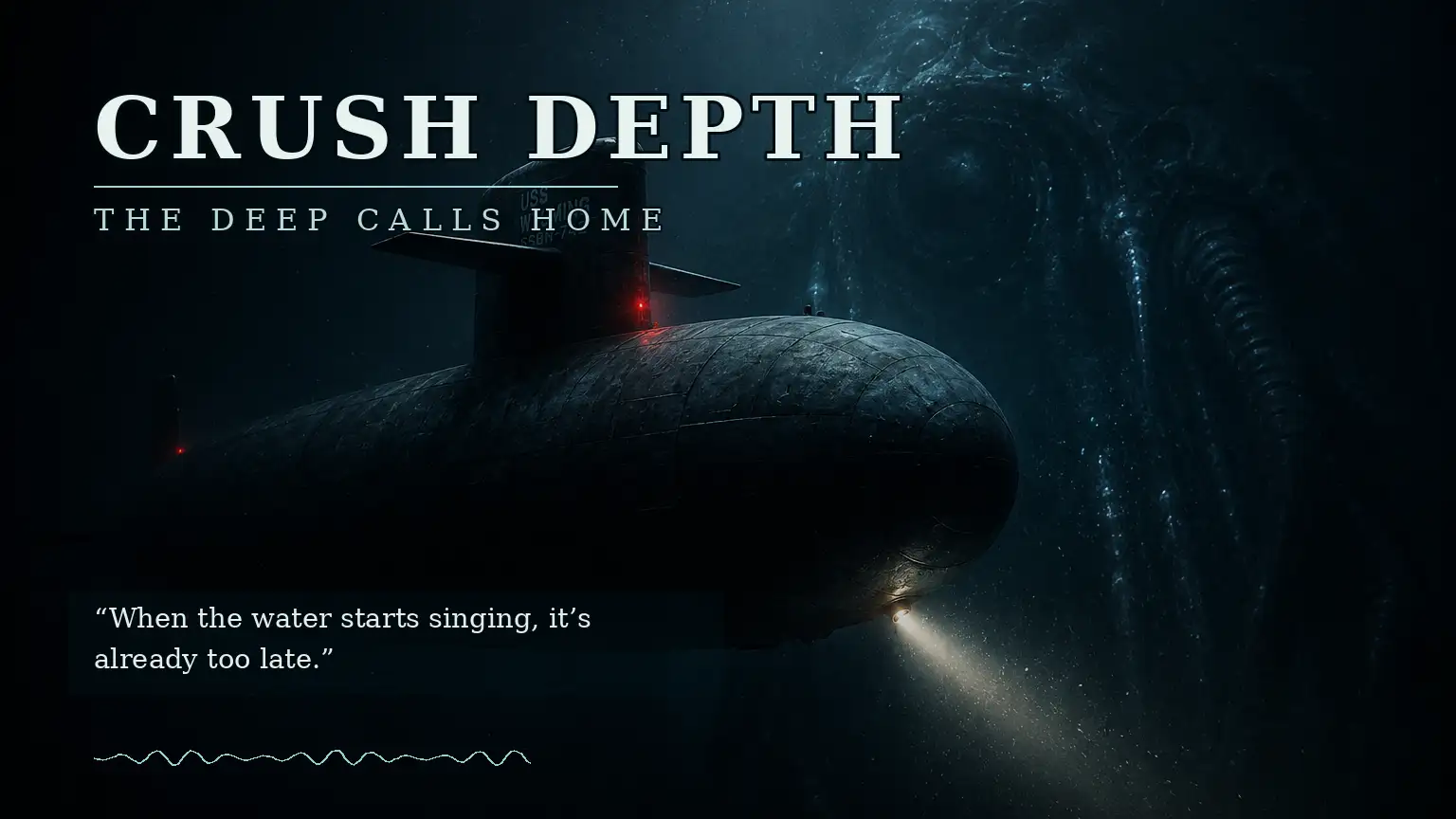
"The Deep Calls Home."
Classification: COSMIC — Eyes Only
The room was soundproof, lead-lined, and officially, it did not exist.
Admiral J.F. Sloane, COMSUBPAC, felt the pressure in his ears as he studied the gaunt man across the table. Dr. Aris Thorne looked like he hadn't slept in weeks — hollow cheeks, fingers stained with what might have been ink or something worse.
"Tell me about this boat, Doctor."
Thorne's voice came out as a dry whisper.
"The USS Wyoming represents six years of my life, Admiral. Built on an Ohio-class frame, but everything else is mine. Composite hull materials that shouldn't exist. We didn't forge them in a foundry; we cultured them in a bioreactor. The structure is a metallic glass lattice interwoven with a living polymer that has its own rudimentary circulatory system. When it detects a micro-fracture, it doesn't just crack — it bleeds a protein-based resin that hardens to a tensile strength greater than the original matrix."
Admiral Sloane's drumming fingers went still. He leaned back from the table, a look of profound distaste settling on his face. "Living? Doctor, a submarine is a machine of steel and wire, not flesh and blood. You're not describing a warship; you're describing an organism. And I will not have my men sealed inside some damn creature I can't trust."
"But even if I could wrap my head around that insanity, you want me to send one hundred and forty of my best men to the bottom of the Pacific for… what exactly? Operation Orpheus tells me nothing except that you people upstairs think you're clever with mythology."
Thorne leaned forward, and Sloane caught a whiff of something chemical, antiseptic. "Our deep-water SOSUS nets have been picking up transmissions from the Mariana Trench. Not whale songs, not geological activity. Something structured. Mathematical. Ancient."
"You're talking about first contact."
"I'm talking about waking something up." Thorne's eyes had the fever-bright look of a man who'd seen too much. "The Wyoming will position herself above the Challenger Deep. I'll transmit one focused sonar pulse at maximum power. If there's intelligence down there, it'll respond."
Sloane felt something cold settle in his stomach. "God help those boys, Doctor."
"Whatever's down there, Admiral, I doubt it falls under your God's jurisdiction."
06 Feb 1982 — 0314Z
VESSEL DEPTH: 650 FEET
HULL INTEGRITY: 100%
EXTERNAL PRESSURE: 290 PSI
Chief Petty Officer Elias Vance, Chief of the Boat, ran his thumb over the photograph dogged down to the sonar compartment bulkhead. His daughter Jill at her piano recital, ten years old, completely absorbed in the music. Twenty-three years riding boats, and he still needed that anchor — something real in a world of pressure and steel.
At the AN/BQQ-5 sonar console, Wyatt Sutton adjusted his headphones and watched the green cascade of data. Kid was barely twenty-two, but he had the best ears on the boat. Farm boy from Tennessee with hands that knew machinery and a mind that could read the ocean's moods.
"Whatcha thinking about, Sutton?" Vance kept his voice low, the way you did when running silent.
"My grandpa used to say the water remembers everything. Every drop that ever fell, every creek that ever ran. Said if you listened close enough, you could hear the whole story of the world."
"Your grandpa sounds like he spent too much time topside in the sun. Let's focus on being sonar operators, not philosophers."
Wyatt grinned. "Roger that, Chief."
The order came down from the control room — not from Captain Garrick, but from the civilian ghost who'd been haunting their boat for two weeks.
"Diving Officer, make your depth nine-five-zero feet."
Silence. Every man knew that number. Nine-five-zero was their theoretical crush depth — the point where their experimental hull might hold, or might fold like a beer can.
"Nine-five-zero feet. Hull holding, but we're reading micro-fractures throughout the forward ballast tanks."
At 0327Z, Dr. Thorne's voice cut through the comm like a blade.
"Sonar, initiate active sonar ping. Maximum power output."
Wyatt's hand hovered over the transmit key. In twenty-two years of living, he'd never been so sure he was about to buy the farm. He pressed down.
PING.
Eight seconds after transmission, Wyatt's display exploded with data.
"Jesus Christ," he whispered.
"Conn, Sonar. I have a contact, bearing one-eight-zero degrees. Range approximately sixty-five hundred yards. It's hanging in the water column four miles down."
"Contact appears to be approximately eight hundred meters in length. That's… that's bigger than an aircraft carrier, sir."
Vance moved to the sonar station. "Son, I've been hunting Russians for twenty-three years. I've seen seismic ghosts and thermal layers that'll fool you six ways from Sunday. But this…" He paused, studying the display. "This isn't a submarine."
Wyatt remembered his grandfather's words about fishing for catfish in the Cumberland River. "When the big ones bite, boy, you don't reel them in. They reel you."
"Execute the order!"
PING.
"Conn, Sonar! Contact now at range sixteen hundred yards, bearing unchanged. Closure rate of over two hundred knots."
07 Feb 1982 — 1600Z (Day 2)
The contact had vanished.
For twenty-four hours, the passive sonar arrays had registered nothing but the most profound silence Wyatt had ever experienced. It wasn't the absence of sound — it was the presence of something actively listening.
Seaman Corbin sat at the auxiliary listening station, his young face pale and confused. "Chief Vance, sir? I keep hearing… it's like a choir. Real faint, right at the edge of everything."
Vance checked Corbin's equipment. All readings normal. "What kind of choir, son?"
"Like church music, but not any church I ever been to. It's beautiful, but it makes my teeth ache."
08 Feb 1982 — 2130Z (Day 3)
The dreams started that night.
Wyatt woke in his rack, drenched in sweat, the taste of salt water in his mouth. He'd dreamed of a city beneath the waves — not ruins, but something alive, breathing, pulsing with bioluminescent light. Streets that moved like arteries, buildings that sang in harmonies that made his bones vibrate.
In the mess hall, he found other men staring at their coffee with hollow eyes.
"Anyone else have weird dreams?" asked Petty Officer Kaito.
Nods around the table. Corbin looked like he'd been through the wringer. "I dreamed I could breathe underwater. Felt more natural than breathing air."
Privately, Vance was worried. He'd seen what isolation and pressure could do to boat crews. They were deeper than any boat had ever gone.
A fight broke out in the torpedo room that afternoon. There were the believers — men who whispered excitedly about contact with something greater than themselves. And there were the loyalists, who just wanted to complete the mission and get back topside. Dr. Thorne moved between both groups like a fever dream, his eyes bright with fanatic purpose.
09 Feb 1982 — 0412Z (Day 4)
It started with the dive planes.
"Conn, Helm! I've lost hydraulic control of the dive planes! We're going down!"
Wyatt felt the deck cant beneath his feet. The depth gauge spun past one thousand feet, then twelve hundred, then fifteen hundred — their absolute crush depth.
The hull should have imploded. Instead, it screamed.
Every man aboard felt it in his bones — the impossible pressure that should have killed them instantly. The air itself felt thick, viscous, like breathing through honey. The submarine's frame should have folded like origami, but something was keeping them intact.
"This isn't physics," whispered Lieutenant Commander Hayes, staring at the depth readings. "This is something else wearing physics like a mask."
At 0415Z, the AN/BQQ-5 sonar system activated itself.
PING.
The return wasn't an echo. It was a response — a wave of structured information that fried half of Wyatt's console and sent a psychic pressure wave through the boat that dropped six men to their knees.
The resonance frequency matched something primal in human physiology — the rhythm of a mother's heartbeat heard from the womb, the pulse of blood through arteries, the deep throb of REM sleep. Men found themselves unconsciously synchronizing their breathing to the alien cadence. Their heartbeats began to match the Deep's rhythm, and with each synchronized pulse, they felt their humanity sliding away like sand through an hourglass.
Corbin looked up from his station, blood streaming from his nose, a beatific smile on his face. "Can you hear it, Chief? It's calling us home."
Chief Kessler from Engineering stood in the hatchway, his voice carrying harmonics that shouldn't have been possible. "We don't need the boat anymore, gentlemen. It's teaching us to breathe water."
Vance grabbed the photograph of Jill, using her memory as an anchor while the song tried to tear his mind apart. "Medical, I need a corpsman in sonar!"
The entity didn't speak in words. It communicated in memories, in visions of drowning that felt like homecoming. Wyatt saw images of humanity's aquatic origins, of the first amphibians crawling from the sea, of evolution as a circle rather than a line.
We remember your beginning, the presence whispered in his mind. We remember breath before lungs, consciousness before individuality.
Vance sealed himself and four others in the torpedo room, but he could hear the loyalists being hunted down by Thorne's converted crew. When Corbin appeared at the sealed hatch, his neck had opened along the sides — not clean cuts, but raw, weeping gills that wept silvery mucus instead of blood.
"Chief," Corbin's voice was layered with harmonics, "it started as an itch in my throat. Just pressure building until the skin split. Didn't hurt, though. Felt like… like finally being able to breathe."
09 Feb 1982 — 0547Z
HULL INTEGRITY: COMPROMISED
WATER INFILTRATION: PROGRESSIVE
The Wyoming didn't implode. It dissolved.
The experimental composite hull became porous, allowing water to seep in with gentle, loving intent. They weren't being crushed — they were being absorbed.
Vance managed one final transmission, his voice steady despite the webbing growing between his fingers. "This is Chief Petty Officer Elias Vance, USS Wyoming. If anyone receives this transmission… do not approach these coordinates. The mission was a trap. It called to Thorne, used him as bait. The crew is… no longer human."
He looked at his hands as the skin stretched and thinned. "Tell my daughter… tell Jill that her father loved her. That whatever I become down below… I love her."
The transmission cut to static.
At the silent sonar station, Wyatt's consciousness floated free from the dissolving shell of his body. The transformation wasn't death — it was communion. The rigid boundaries of his human self softened and flowed into the vast presence of the Deep.
All that remained was the pulse, the perfect emptiness that was also perfect belonging.
FROM: COMSUBPAC / TO: CNO
SUBJ: USS WYOMING — INVESTIGATION TERMINATED
12 FEB 1982-1200Z
Search and rescue operations for USS Wyoming terminated following loss of USS Hawkbill (SSN-666) and research vessel USNS Mercy. All vessels reported identical acoustic anomalies prior to communication loss.
Confirmed casualties: 140 (Wyoming), 115 (Hawkbill), 47 (Mercy).
[CLASSIFIED ADDENDUM — EYES ONLY]
The specimens we recovered from Mercy's final dive aren't human. They remember being human but serve a different purpose now.
They can speak. They can plead. They remember their families, their homes, their fears.
But when they smile, you can see the ocean moving behind their teeth.
Recommend immediate termination of all recovered specimens.
The Deep is not benevolent.
—JFS
This is Sonar Technician Second Class Wyatt Sutton, USS Wyoming.
My grandpa was right about the water remembering everything. But he never told me what happens when it decides to remember us back.
We didn't die down here. Death would have been mercy.
The presence in the Deep doesn't want to destroy humanity. It wants to perfect us.
We're coming home now. All of us.
But we're not the same people who left.
Tell them… tell them that when the water starts singing, it's already too late.