
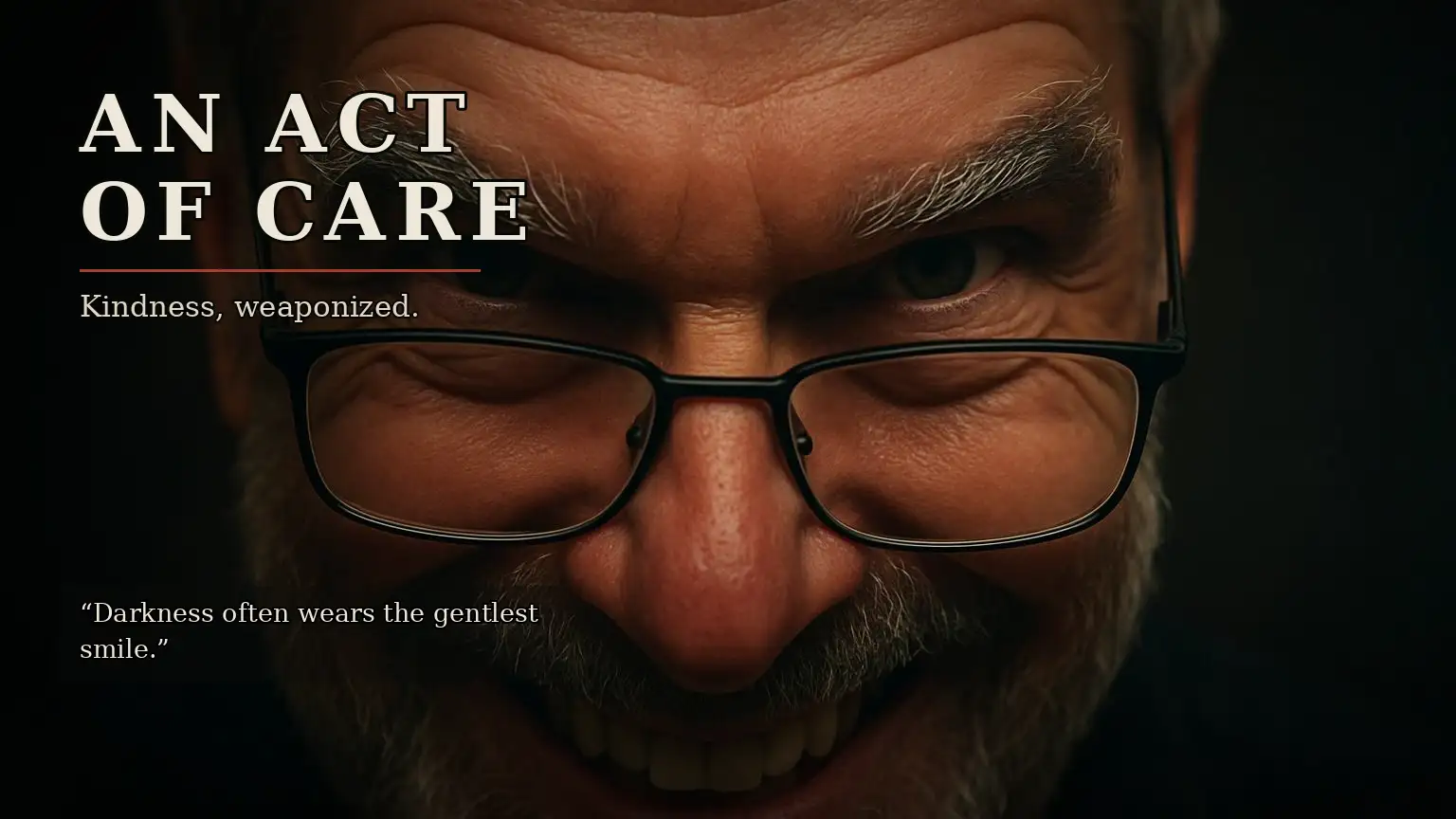
The pediatric waiting room was Herbert Carrow’s laboratory. For forty-three years, he’d studied the patterns of grief, the mechanics of desperation, the precise moment when hope curdled into something useful. He saw the parents as specimens, their love a variable he could precisely manipulate. He also had a theory about buttermilk. Warm buttermilk, specifically. People would drink almost anything if you told them it was good for their nerves.
Herbert carried his buttermilk in a beaten thermos and poured it into paper cups like coffee, though it was far too thick for that. The liquid came out in slow, glugging ribbons—viscous and pale—with occasional soft clumps that plopped wetly into the cup like yolk breaking in spoiled milk. The smell was sharp and sour, clinging to his cardigan like damp wool. The older nurses breathed through their mouths when he passed. Younger staff, mistaking his quiet strangeness for harmless eccentricity, called him Herbie. He hated the name, the way it felt small and sticky in his ears, but he tolerated it. It was part of the camouflage.
He stood beside the waiting area with two cups, his gaze drifting across the room with practiced concern. He observed the subjects. A father staring blankly at the cartoon fish on the wall, already defeated. A young couple whispering in frantic, tight circles, their fear a measured frequency. And then he saw her. The woman in blue. She was alone, her posture radiating the unique tension of a parent holding a live wire, trying not to let it touch anything. She was perfect.
He approached her, his footsteps silent on the linoleum. The antiseptic smell always brought him back to age seven, watching his mother argue with doctors who wouldn't listen, who called her "hysterical" for wanting answers he now knew she deserved.
The little girl—Julie, the chart said—was asleep against her, tiny fingers wrapped around a pink inhaler the way she used to clutch her elephant, Rosie, before doctor visits became a regular thing. The mother—MaryAnn—was stroking her daughter’s hair with a hand that trembled almost imperceptibly.
“You look like someone who could use something settling for your nerves,” he said, his voice soft, barely rising above the hum of the lights.
She glanced up, eyes rimmed red and startled. “What is it?”
“Warm buttermilk. An old remedy. Very calming...” His voice trailed off, his eyes settling on the child. “My grandmother swore by it.”
MaryAnn took a small, reluctant sip. The warm mouthful was thick and unnatural, the texture sliding and clinging as she swallowed—chunks of curdled dairy coating her throat like putrid vomit. Her throat convulsed and she gagged openly, doubling forward. “Oh God," she whispered, pressing her hand to her mouth. "That's disgusting."
Herbert settled into the seat beside her. “The best remedies usually are.” The sour taste lingered, reminding her of the morning sickness she'd had carrying Julie—that same helpless nausea, the same feeling of her body betraying her.
“She wheezes at night.” MaryAnn’s words came out in a rush, a dam of composure finally breaking. “Sometimes I wake up just listening. I hold my breath to hear hers. Every pause feels like an eternity.”
Herbert nodded slowly, his expression one of deep, solemn understanding.
“The doctor said it’s mild, but…” She shook her head, her voice cracking. “What if it’s not? What if something else is hiding under it? What if we’re missing something vital?”
He tilted his head slightly, his gaze going distant, as if searching a vast, private archive of sorrow. “I’ve seen cases where the obvious diagnosis wasn't... the whole picture.” His voice dropped to a murmur, forcing her to strain to hear. “A few years back. A family... very similar situation. Same age, similar symptoms... Took months. The family had to push. Pretty hard.”
MaryAnn leaned back, the information settling like a stone. “I just feel like they think I’m being hysterical.”
He placed a hand on the armrest between them, not touching but radiating a steady warmth. “Trust your instincts,” he said, his voice now clear and firm, an anchor in her sea of anxiety. “You know your daughter better than anyone.”
That night, the wheezing came, sudden and wet. MaryAnn shot upright, heart pounding. “Julie? Baby, stay with me—” The sound transported her instantly to her own childhood bedroom, listening to her father's emphysema through thin walls, counting his labored breaths until dawn.
The door burst open. Nurses swarmed. By the time the episode subsided, Julie was breathing slow and steady again. “Just a flare-up,” a nurse said brightly. “Her levels are good now.” As the nurse turned to leave, she saw Herbert approaching MaryAnn in the hallway. The nurse’s professional tension eased slightly. “Oh, good,” she murmured, more to herself than anyone. “He’s with her.” A younger colleague once asked who he was. The nurse had just shrugged. “He’s not official staff, but he’s always been here.”
In the hallway, MaryAnn clutched her phone. The next morning, she showed the video to the attending physician, her hands trembling as she held it out. “See? This is what I’m talking about. This isn’t ‘mild.’”
The doctor watched with a practiced, patient expression. “I understand why this is frightening, MaryAnn. It looks very dramatic. But her oxygen saturation never dropped into a danger zone. Her recovery was quick. This is, clinically speaking, consistent with a significant flare-up. We’ll keep monitoring.”
He handed the phone back. His tone was kind, but the message was clear: You’re overreacting.
That afternoon, she saw Herbert by the vending machines. He didn’t need to ask how the meeting went; he could see it in her face.
“They dismissed it, didn’t they?” he said softly.
Tears sprang to her eyes. She just nodded.
“The right documentation is only useful if someone is willing to look at it properly,” he murmured, unscrewing his thermos lid. “Sometimes, you have to find a community that will.”
Later, in the hospital parking lot, Herbert sat in his car with his notebook open.
Day 4: Induced episode successful. Duration: 3:47. Subject documented extensively. Physician review resulted in dismissal, as anticipated. Subject's emotional investment is high, similar to my own mother's. But this time, the data will be clean. Uncorrupted by hysteria. Subject is now primed for external validation sources.
Next intervention: guide subject to pre-seeded online forums. Introduce doubt regarding medical staff competency. Correcting their diagnostic blindness requires a foundation of mistrust.
The smile that crossed Herbert’s face was small and cold. Through the windshield, he could see the hospital's children's wing, the same amber glow that had lit his mother's face forty years ago as she stood at his bedside, desperate and ignored.
For the next two days, MaryAnn lived in a fog of sleeplessness and obsessive research. The hospital became a landscape of perceived threats. Every beep of a machine was a prelude to disaster. Every hushed conversation between nurses in the hallway was about her, about Julie.
She plunged into the internet, the blue glow casting shadows that reminded her of Julie's newborn ICU stay—those endless nights watching monitors, learning to read danger in numbers and lines.
The phrase Herbert had used—“a community that will look”—echoed in her mind. She found them in private Facebook groups and ancient, text-based forums. “Warriors for the Undiagnosed.” “Mothers Against Medical Gaslighting.” Here, her fear was not a symptom to be managed but a credential. She posted her story, uploaded the video.
The replies were a tidal wave of validation. They did the same to me! You are her only advocate! Keep fighting! That is NOT a simple flare-up. My son did that right before he was diagnosed with [rare, terrifying condition].
A private message appeared from a user named “Lisa S.” The profile photo was a single, bright sunflower. MaryAnn, I saw your video. I cried because it was like watching my own story. The doctors called me hysterical for six months while my daughter wasted away. You’re not crazy. If you want to talk, I’m here. MaryAnn typed back immediately, her fingers flying across the screen, a wave of profound, desperate relief washing over her. She had found her people. Over the next day, “Lisa” became her lifeline, feeding her articles, suggesting symptoms to look for, reinforcing the idea that the hospital staff were the enemy.
Day 6: Subject located pre-seeded forum content as anticipated. Engaged with "Lisa S." persona extensively. Online validation phase proceeding ahead of schedule. Subject showing increased agitation toward medical staff. Ready for escalation to fabrication phase
Nine days after she first met Herbert, on a Tuesday morning, MaryAnn stood outside the doctor’s office, heart hammering. The EEG results for the “seizure” she’d reported had come back normal. It was another dismissal. She felt a surge of defiant anger. They were missing things because they weren’t looking hard enough.
Later that night, she stood over Julie’s bed with a small makeup brush from her own purse. She dabbed a purplish shadow beneath her daughter’s eyes, blending it carefully into the delicate skin. Julie stirred, murmuring something in her sleep, and MaryAnn froze, her heart seizing. But the child settled again.
“Just for the picture,” she whispered, her voice trembling. “They need to see. They have to see how tired you are.” It felt like a necessary lie, a way of translating the invisible truth of Julie’s suffering into a language the doctors couldn’t ignore.
She took the photo and posted it to the group. Deteriorating energy levels and concerning bruising. Still no answers. The supportive comments flooded in, each one a small dose of righteousness.
The next morning, she cornered Herbert. “You said you’ve seen this before,” she murmured. “What happened to the other girl?”
He paused, his eyes unfocusing. “They waited. And with each test that came back normal, they became more certain the mother was the problem. By the time they looked deeper... her lungs...”
“What?” MaryAnn leaned closer. “What about her lungs?”
Herbert looked at her, his expression grim. “They were destroyed. Scarred beyond repair.”
Day 9: Subject entered fabrication phase. Visual symptom enhancement documented via social media. EEG falsification successful - normal results reinforce subject's persecution narrative. Medication compliance becoming sporadic. Approaching critical threshold.
That night, standing by Julie’s bed with the evening medication in a small paper cup, MaryAnn hesitated. What if this medicine is masking the real problem? she thought, the idea planted by Lisa S. now taking root. What if it’s stopping the real symptoms from showing? For a full five minutes, she stood frozen, the cup in her hand, waging a silent war against the doctors’ instructions. Finally, she poured the medicine down the sink.
By two A.M., her fingers had gone bluish. She hit the call button, already filming.
The next afternoon, a child psychiatrist asked if she was getting enough sleep. For the next two days, she felt their eyes on her. The nurses’ smiles were too bright, their questions about how she was sleeping too frequent. She was no longer just a concerned mother; she was a case study. The pressure was a physical weight.
She saw Herbert in the hallway. He didn’t offer buttermilk this time, just a paper napkin. There was a smudge of lipstick on it, someone else’s.
“They think I’m making things up,” she said. “The doctors, the nurses… they look at me like I’m... causing it.”
His eyes softened. “When mothers see what others won’t, they call it hysteria.” He let the word hang in the air. “You’re doing everything right.”
That night, Julie refused her evening medication. “No,” she said, her voice quiet but clear.
“Sweetheart, you need it. You’ll get sick again.”
Julie shook her head, pulling the blanket higher. “You make me sick.”
MaryAnn stared at her daughter's small profile, remembering how Julie used to climb into bed with her during thunderstorms, how she'd press her ear to MaryAnn's chest and say, "Your heart sounds like home." Now that same voice was telling her she was poison. It wasn't an accusation—just a quiet observation, delivered like fact. The words landed and sat in the quiet room, cold and heavy, the simple truth reverberating in the space between them. For a long, silent moment, she felt nothing but the hum of the machines and the weight of that sentence.
She waited until after midnight, until the floor was quiet, until the words had faded into a dull, familiar ache of desperation. Herbert's voice replaced them. Sometimes they need help showing symptoms. Slowly, she rose. She placed a small, firm pillow across Julie’s chest and leaned her weight down—just enough to watch the line on the monitor spike and the alarm begin its frantic chirp.
Julie gasped, a small, wet sound of betrayal.
MaryAnn snatched the pillow away, a tremor of revulsion shooting through her own hands. The fabric felt alien, obscene. What did I just do? The thought was a splinter of ice in her brain, a flash of her own monstrousness—instantly buried as she caught her daughter’s expression for a split second before the nurses came rushing in.
Not fear.
Recognition.
MaryAnn woke in a chair outside Julie’s room. A psychiatric consult had been requested. She just kept replaying the video. The pillow. The spike. The look in Julie’s eyes.
She found Herbert by the vending machines. “I—” she started, her voice breaking. “The doctors, the staff… they’re saying I need an evaluation. That I’m interfering with her care.”
He stepped forward. “They’re afraid of what you’ve uncovered,” he said, his voice a low, steady hum. “You’ve threatened their narrative. It is easier for them to pathologize you than to admit their own failure.”
“I’m scared,” she whispered.
“That’s normal.” He placed a candy bar in her hand. “It means you’re close to the truth.”
“Then why does it feel like I’m disappearing?”
He didn’t answer. Just gave her that same soft smile and turned away, disappearing down the hallway like vapor.
Day 12: Final event sequence complete. Subject exhibiting dissociative symptoms. Child stabilized. Staff now treating mother as primary concern. Psychiatric hold recommended.
Outcome: successful emotional inversion culminating in manufactured harm event. Child dissociative. Mother compromised. Volunteer profile remains intact. The system self-corrects against the inconvenient parent, as designed. Next subject pending: Room 512. Single father. Promising strain of fatigue. ⸻
The hospital placed MaryAnn under observation. She never mentioned Herbert. Not once. Not even when he visited, bearing flowers and that same beaten thermos. He stood at the foot of her bed. “They’re going to take good care of Julie now.”
MaryAnn turned her face to the wall.
In the pediatric wing, a new family had just arrived. A father alone this time, his son coughing wetly into a sleeve. The boy was seven. The diagnosis was still unclear.
Herbert walked slowly down the corridor, two paper cups in hand, cardigan buttoned to the top. The thermos steamed faintly in the recycled air.
The father looked up as he approached, his face a mask of exhaustion.
“You look like someone who could use something settling for your nerves,” Herbert said, his voice a gentle murmur.
The man blinked. Nodded.
Herbert handed him a cup.
The smile that followed was small and serene. The kind of smile that comes only from perfect practice.
And perfect results.